Test

The Ballad of the West

TwelfthNight

by Christian Riboldi, dramaturg As we discussed last time, Shakespeare has been changed and adapted over time for a variety of reasons. Sometimes it's in order to be true to Shakespeare, and other times it's purpose is to appeal to a different audience. In our version of Twelfth Night we have set the stage in the Wild West. Sebastian and Viola were separated in tornado and now Viola finds herself in a town called Illyria. But this isn't your regular western Shakespearean town. It's a town where everyone can sing and dance...well almost everyone. As you can imagine, cutting Twelfth Night down from 140 minutes to 50 minutes is a major feat. In order to do so many scenes and a few characters were merged with others in order to simplify and essentialize the plot. In addition to cutting, a few musical numbers are added throughout the script to clarify and connect one scene to another. Our script adapter Rick Curtiss and our director Professor Jones did an amazing job creating the lyrics to accompany these comical musical parodies Every song that is in this show is an original parody of a famous western song and will be sung and accompanied by our talented cast. We have a guitar, trombone, tambourine, ukulele, percussion, and even a cow bell.

As an example here are some of the lyrics to a song sung by Sebastian as he enters sung to the tune “I’m So Lonesome, I Could Cry”.

I bet you all forgotten me, I’m an unlucky guy, Stuck out in the desert alone, I’m so thirsty I might die.

I only had one can of beans, for when the end was nigh, a coyote came and stole the can, I’m so hungry I might die.

At night the critters crawl on me, by day the vultures fly, I met a snake, it bit my foot, I’m so poisoned I might die.Hey what is that up on the ridge, Is that a ranch I spy, I hope it has some pretty girls, If not, I just might die.

I hope you can imagine how fun this show is going to be now! Here are the links to the other songs that inspired our parodies. We hope to see you at the show so you can hear the rest of our fun songs! Until next time!

[embed]https://www.youtube.com/watch?v=-K4BvF_sb3Y[/embed]

[embed]https://www.youtube.com/watch?v=qGEubdH8m0s[/embed] [embed]https://www.youtube.com/watch?v=cDm_ZHyYTrg[/embed] [embed]https://www.youtube.com/watch?v=mjdRgBAY278[/embed]

[embed]https://www.youtube.com/watch?v=rN2U5wkhRWc[/embed]

Related Articles

data-content-type="article"

Oscar Wilde - A Timeline

December 02, 2020 12:00 AM
by Charisse Baxter, dramaturg
overrideBackgroundColorOrImage= overrideTextColor= promoTextAlignment= overrideCardHideSection= overrideCardHideByline= overrideCardHideDescription= overridebuttonBgColor= overrideButtonText= promoTextAlignment=
data-content-type="article"

WDA Concert Readings Go Virtual

November 28, 2020 12:00 AM
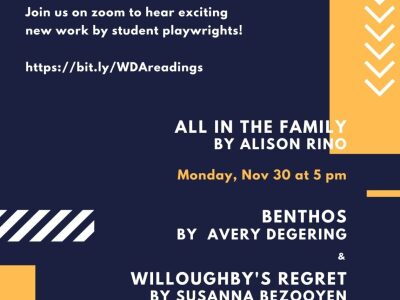
by Shelley Graham, dramaturgy supervisor Each fall semester we offer a course called "Writers Dramaturgs Actors Workshop." Throughout the semester, students in the class will workshop, develop, and offer feedback on select plays by fellow student writers. The plays are carefully selected for this opportunity from among numerous student entries so that each week in class we get to improve our skills as dramaturgs while we help playwrights improve their skills as writers. At the end of the semester, we get to work on our acting skills, when we offer public concert readings of the plays we've been working on all semester. New eyes and ears on these drafts are immensely valuable, and so we invite the public to these readings. An invaluable aspect of the concert reading is the brief discussion that immediately follows when we have those in the audience (who haven't been working on these scripts all semester long) share their first impressions and questions about the new plays. We invite everyone to join us for these readings performed on Zoom this year - we would love to share our work with you and hear your feedback! You are welcome to join any and all of these performances! Click here to join.
overrideBackgroundColorOrImage= overrideTextColor= promoTextAlignment= overrideCardHideSection= overrideCardHideByline= overrideCardHideDescription= overridebuttonBgColor= overrideButtonText= promoTextAlignment=
data-content-type="article"

Fan-atical Victorian Conversation

November 28, 2020 12:00 AM
by Charisse Baxter, dramaturg Smoke signals. Pictographs. Hieroglyphics. Morse Code. Computer programming. Lemon juice. Emojis... and so much more! The quest to communicate has been constant throughout the history of humanity, and along the way, all kinds of methods of exchanging information have either lost their meaning for a while, or were always intended to be secret and used only by those ‘in the know.’ During the Victorian era, when Oscar Wilde was writing his society-skewering plays, there were several communication methods employed by those who were in on the underground code-speak. One such method was the ‘language of flowers’, with which messages and feelings could be expressed by particular floral arrangements. Another, slightly more secretive (and therefore more fun) method, was ‘fan language’, in which ladies and gentlemen could conduct entire conversations under the noses of their chaperones. Take a look!
overrideBackgroundColorOrImage= overrideTextColor= promoTextAlignment= overrideCardHideSection= overrideCardHideByline= overrideCardHideDescription= overridebuttonBgColor= overrideButtonText= promoTextAlignment=