
Our Own Secret Garden

The power of healing and growth is a topic not unknown to students at BYU. Educators and learners alike were asked to stretch their capacity to hold both powers in one hand as they were transplanted from their on-campus home in the Harris Fine Arts Center, to the new West Campus building, formerly known as the old Provo High School. The college of fine arts and communication, which includes Theatre, Media, film, Art, and Design departments, had to establish new communities, while major construction projects prevented them from being as close to the rest of campus as they might like to be.

As the production team of The Secret Garden began conceptualizing what the show might look like in a high school venue, Belle Frahm and I felt a great need to do what dramaturgy does best - reveal the world of the play in a practical manner, one that benefits those who see the show, and those who may not. Thus began the “Our own Secret Garden,” project, one in which we collaborated with students, faculty, and community members to get our hands in the dirt and plant a real garden, a garden that all students at Provo High School could enjoy. Once the space was selected, the real work began - and there was a lot to do.

The courtyard before the Secret Garden project.
Photo by Charlotte Westover

Because we live in the desert, we did a lot of research to ensure that the plants we selected might survive the Utah climate, while also remaining conscious of available resources. This required us to think through ways in which we could conserve water while simultaneously giving our garden the nutrients it would need to blossom. With the help of the BYU Grounds and planning committees, we collaborated on a “water - wise” garden design which gave us the freedom to create something beautiful, lasting, and environmentally conscious.

In the musical, The Secret Garden, there’s a real sense of something new being borne out of something old. Growth and healing are not always found by abandoning your past, but rather, can be illuminated by taking who you once were and allowing it to transform the person you are now. Belle and I wanted to bring this feeling into the garden by repurposing as many materials as we could. Planter boxes, compost, seeds, and other materials left behind at the high school during our transition added a deeper layer of belonging to the project as we incorporated them into our garden concept.

Gathering compost materials.
Photo by Belle Frahm
Newly filled planter boxes near the garden project.
Photo by Charlotte Westover

By mid April, we were ready to get our hands into a “bit of Earth,” and hosted our first garden workshop with the cast of The Secret Garden. With weeds to pull, leaves to rake, and soil to turn, the cast got busy on transforming this overlooked space at the high school into one that our community and student body could enjoy. We even did chalk art to commemorate the work they were doing both in the show, and in our literal garden.

Another workshop was held in July of 2023 and the community was invited to come and work alongside the cast to further beautify our West Campus space. A path to our own “Mother tree,” was dug out, soil was laid down, and we finally started planting our shrubs, bushes, and flowers.

About a month before The Secret Garden opened, we did one last workshop with the cast in the dark! Weeding, raking and plenty of singing ensued while we got our hands into the soil one last time before the show opened. The cast even performed a beloved song from the show called, “Come Spirit, Come Charm,” which filled the air with a magic we’ve clung to ever since.

Because the timelines of construction on main campus aren’t set and we still face quite a few unknowns, we are so grateful for the cooperation and support of BYU in allowing us to create a student space here at the high school. It is our belief that everyone is deserving of “A bit of Earth,” and we know firsthand that it can often be hard work to grow where you’re planted - But what a wonderful reward it is to see the blossoming that follows! We encourage you to consider your own growth, how you’ve been nourished, and what your growth has done to benefit this ever changing world. We likewise welcome you to join us in Provo High Schools’ very own Secret Garden near the student commons! Can’t wait to see you there!

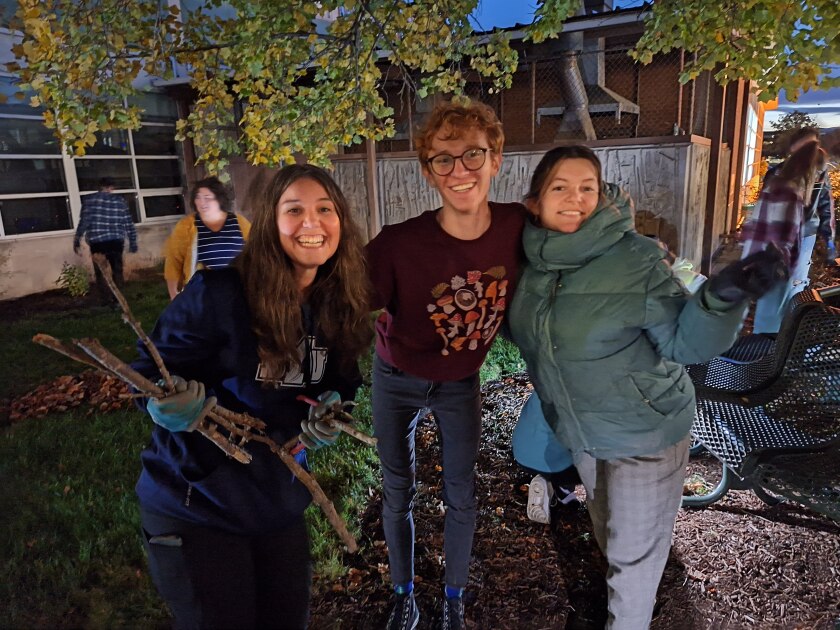
Taking care of the garden during an evening rehearsal
Photo by Charlotte Westover
Cast and crew cultivate the garden
Photo by Charlotte Westover

Related Articles

data-content-type="article"

Post Mortem Photography

April 20, 2021 12:49 PM
by Makenna Johnston, dramaturg As you can see in The Turn of the Screw, the Victorian era was shrouded in death. Complications from industrialization, as well as high disease and infection rates, caused high mortality rates, especially in younger demographics. Because of this, the living found comfort in one of the most fascinating mourning practices of the Victorian era: post-mortem photography. Due to the high cost of photography during the Victorian era, post-mortem photographs were often the first, and only, photographs families had taken of their loved ones. The mourning would commission a daguerreotype or a photograph taken by a long-exposure camera. Long exposures when taking photographs meant that the dead were often seen more sharply than the slightly-blurred living, because of their lack of movement. The dead were carefully posed to appear as if they were still alive. Some deceased were propped against stands or furniture while others were surrounded by their family members or favorite toys. Once the daguerreotype photographs finished developing, some photographers would paint eyes or add blush to the finished photograph to make the deceased appear more lifelike. Below are more examples of post-mortem photography. How do you choose to remember those who have passed on? Sources: Bell, Bethan. “Taken from Life: The Unsettling Art of Death Photography.” BBC News, BBC, 4 June 2016, www.bbc.com/news/uk-england-36389581. Diaries, Ghost, et al. “Memento Mori: The Macabre Victorian Art of Death Photography.” The Occult Museum, 16 May 2017, www.theoccultmuseum.com/memento-mori-macabre-victorian-art-death-photography/. Leahabaza. “Picturing the Dead: Victorian-Era Mourning and Post-Mortem Photography.” Woodland Cemetery History, 20 Aug. 2018, woodlandcemeteryhistory.wordpress.com/2018/08/20/picturing-the-dead-victorian-era-mourning-and-post-mortem-photography/.
overrideBackgroundColorOrImage= overrideTextColor= promoTextAlignment= overrideCardHideSection= overrideCardHideByline= overrideCardHideDescription= overridebuttonBgColor= overrideButtonText= promoTextAlignment=
data-content-type="article"

Interviews with the Student Devising Team

April 19, 2021 07:44 AM
by Makenna Johnston, dramaturg In a ‘special projects’ theatre class held between January and March of 2020, four students and their professor began devising a show. Their devising team? David Morgan (professor), Clara Wright, Mikah Vaclaw, Sten Shearer, and Dylan Wright. Their source text? The Turn of the Screw, a novel by Henry James. Though the team’s original devising process was cut short due to the Covid-19 pandemic, aspects of their invaluable contributions to the production live on. Each student deviser's unique perspective about the story and devising process are explored below. Clara Wright Our professor David Morgan had the idea to create a devised piece of theatre to take to the Edinburgh fringe festival with a group of students. He was drawn to the script of the Turn of the Screw, but wanted to do his own take on it, so he decided to create a new adaptation of the original book with a group of students. He was drawn to the eerie nature of the piece, the elements of horror, and the slow descent into madness of the governess. I joined Dave's class to write and devise this script because, first of all, working with Dave has always been a pleasure, but the story was intriguing to me as well. I loved the idea of studying and understanding a layered female character. I don't think there are enough interesting female characters out there at the moment. The governess was affected greatly by societal pressures and a deep, depressing history that drove her to madness when she arrived at Bly. The story was mesmerizing. I was also excited to work the muscle of creating a new piece of theatre. I am not confident in my writing abilities, but it was exciting to take a piece of literature that already existed and make something new and interesting out of it, using visual elements that you can't get from reading a book. We not only wrote dialogue, but we also wrote out ways we could use movement, sound, lighting, puppetry, and more to tell the story in the most effective way possible. The devising process was a blast! Dave would tell us what scene he wanted us to write and we would each go home and write out our own interpretation of the story. The next class, we would get together and go over which elements of people's scenes we liked best, which moments were the most clear, and which lines we for sure wanted to keep in the final script. Sometimes our interpretations were so different and unique that it was difficult to choose which direction the piece needed to go. Ultimately, Dave would piece together each of our scenes into a cohesive script. Other moments I enjoyed were when we would put scenes on their feet and act them out to see how they translated to the stage. The introduction especially benefited from this exercise. The last exciting part of the devising process that I'll talk about is writing the music. I hadn't written original music like this before so it was such a cool experience creating sound like this for the first time. I didn't ever think about what scene I was writing for, but Dave told me what tone he was looking for in a piece of music and then I experimented until I found something I liked by layering on different sounds I could make on my violin. It was an overall thrilling experience! Turn of the Screw example music Turn of the Screw example music 2 Mikah Vaclaw Because of COVID, we didn’t get to fully get the script up on its feet, so we focused a lot on writing. First, we all read the book over Christmas break, and when we had our first meetings as a group, we talked about what stood out to us in the story and what we wanted our retelling of the story to be. Something we really wanted to explore was the idea that the ghosts were actually things born out of trauma the governess had experienced in her youth, and how she was the only one that could see them/was affected by them. We also wanted to explore jealousy between Mrs. Grose and the Governess. Once we had fleshed out what was important to us, we started writing. Dave would tell us what scene he wanted us to write for homework, and we’d all come back with our different written versions of that scene. Then, in class, we would read them aloud together and talk about what we thought worked, and what didn’t. Dave would then take all of our scripts and compile them together into one cohesive scene. We were able to start toying with the introduction to the play, and Clara wrote some really cool violin music for it. Sten Shearer The process of devising the script was the five of us (David Morgan, Clara and Dylan Wright, Mikah Vaclaw, and myself) would get together a couple times a week. Initially, David gave us some conceptual ideas he had for the show (like using movable screens that could utilize shadow work). Then we all read the original story. At each meeting, we would assign a chunk of the original story as our writing assignment. Using that chunk of the story as inspiration, the four students would go home and write a scene that translated that section of the original story into a play scene. Through that process, we collaboratively came to an understanding of the themes that we wanted the play to explore as well as theatrical devices and ideas that we thought would work well in putting the play on its feet. Simultaneously to writing these scenes, we were also using our class time to experiment with staging and blocking using the earlier scenes that we had written. So for instance, when we were about halfway through writing the script, we were also staging what the early scenes would look like to help test if the script we were writing worked in practice as well as on paper. Dylan Wright We chose this project because we obviously needed something in the public domain that we wouldn't need to pay royalties for, but aside from that this story really highlights the mental turmoil of a young governess as she grapples with her duties as a woman and her place in the world religiously as well. We took this story to an extremely dark place-- it has since been edited for this particular production-- that orbited around this idea of religious toxicity, something all too familiar in Utah. We felt that it was important to excavate and expose the uncomfortable and truly ugly parts of religion and the toll it can take on us. I wanted to work on this project because Mikah, Sten, Clara, and Dave are some of my favorite people and artists. The driving force really, as mentioned earlier, is that we wanted to create. We were all itching to create something. None of us needed this class credits-wise so the idea of coming together to tell a ghost story that echoes modern themes in a bare-bones, devised manner was extremely appealing. Unfortunately we were never able to perform this production because of COVID. But the devising process was an invaluable gem. We would each read the same chapter of The Turn of the Screw and then come to class with our own interpretation of this chapter in scene-form, creating dialogue and stage directions. Dave would then pull the pieces from each that rendered a clearer, more specific story and then we would go from there. When we would arrive in class we would also read each other's scenes out loud to get a feel for them. It was a marvelous process.
overrideBackgroundColorOrImage= overrideTextColor= promoTextAlignment= overrideCardHideSection= overrideCardHideByline= overrideCardHideDescription= overridebuttonBgColor= overrideButtonText= promoTextAlignment=
data-content-type="article"

Turn of the Screw Study Guide

April 09, 2021 12:03 PM
2020-2021 SEASON, ILLUSIONARY TALES TURN OF THE SCREW by Makenna Johnston, dramaturg
overrideBackgroundColorOrImage= overrideTextColor= promoTextAlignment= overrideCardHideSection= overrideCardHideByline= overrideCardHideDescription= overridebuttonBgColor= overrideButtonText= promoTextAlignment=